
The Power of “Yes, and…”
Mama Bear

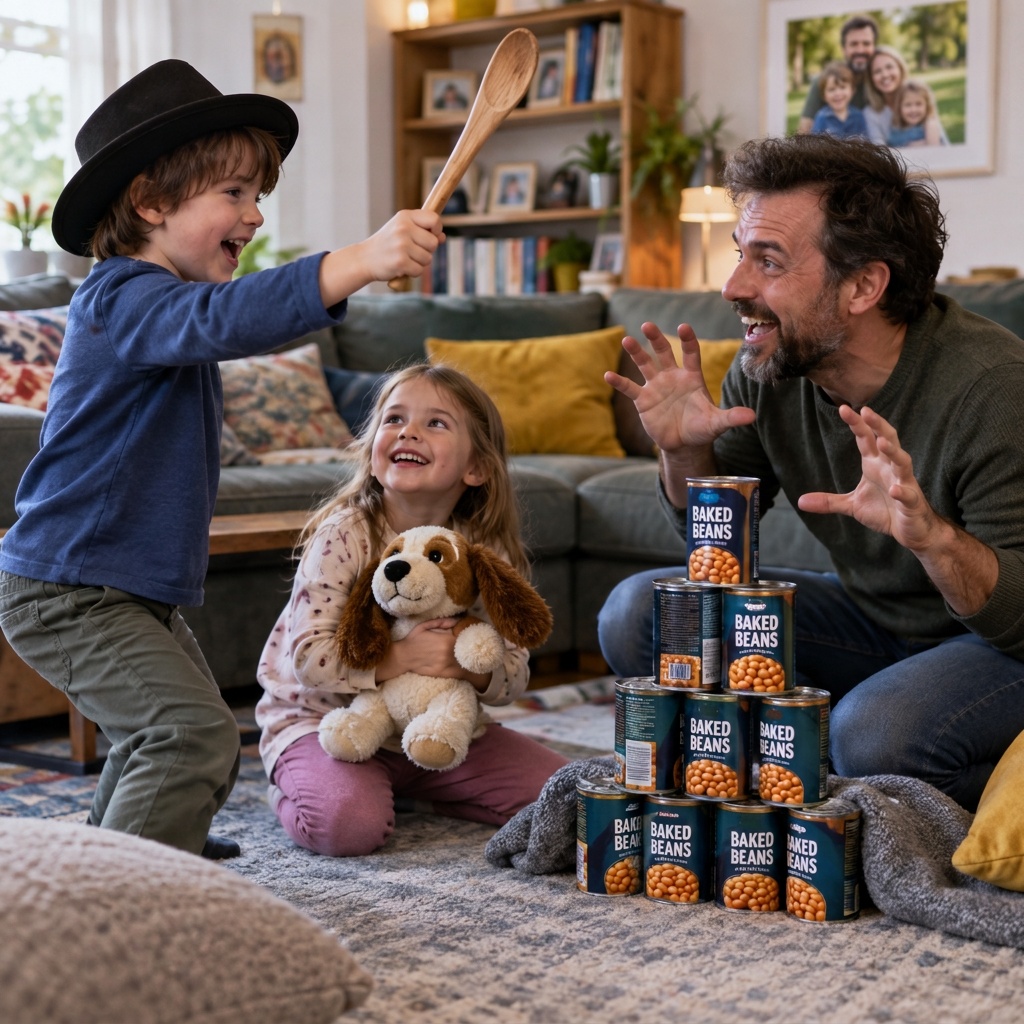
Children have a lot of ideas.
Some are brilliant. Some are hilarious. Some are wildly impractical and involve turning every cushion in the house into a boat while you’re halfway through making dinner. As parents, our instinct can sometimes be to shut those ideas down.
“No, that won’t work.”- “No, that’s not how you do it.”- “No, we haven’t got time.”- “No, the sofa cushions are not lava-proof.”
And, to be fair, sometimes no is absolutely the right answer. Children need boundaries, parents need sanity, and sofas occasionally need protecting. But when it comes to play, imagination and creativity, there can be something incredibly powerful about saying yes. Not necessarily “yes, you may dismantle the living room.” More like: “Yes. And… what happens next?”
The magic of “Yes, and…”
There’s a simple rule used in improvisational theatre called “Yes, and…” When another performer introduces an idea, you accept what they’ve given you – the yes – and then add something of your own- the and.
Imagine someone says: “We’re astronauts and we’ve just landed on Mars.” Instead of saying: “No we’re not. We’re standing in the kitchen” you might say: “Yes! And I think there’s something moving behind that rock…”
Suddenly, you have somewhere to go.
The first response stops the story. The second builds it. And children are basically tiny improvisers. They’re constantly throwing ideas into the world and waiting to see what happens.
“This stick is my magic wand.”- “You’re the dragon.”- “The floor is lava.”- “This cardboard box is our spaceship.”
When we join them in those ideas, even briefly, we give their imaginations somewhere to run.
You don’t have to bring all the inspiration
If you want to play with your children, it can be tempting to think that you need to arrive with all the entertainment already planned. You really don’t. In fact, sometimes one of the best things we can do is let our children lead.
If they tell you the cardboard box is a spaceship, you don’t need to start designing the control panel, assigning everyone a job and researching the atmospheric conditions on Jupiter. Just get in the box, ask where you’re going, ask what that button does, ask why there’s suddenly an alien in the kitchen.
When we follow rather than direct, we’re showing children that their ideas have value. And that’s a pretty powerful message.
Of course, sometimes getting to that starting point is the difficult bit. We might want to engage with our children and encourage their imaginations, but after a long day, when they’re running riot, coming up with something that will entertain their creativity can feel like quite a big ask.
That’s where a little prompt can make all the difference.
A simple activity, an unusual question, a challenge or the beginnings of a story can give a child something to grab hold of. You provide the spark; they decide where it goes.
That’s something we think about a lot at OK, Let’s Play! Our activities aren’t about scripting every moment of playing or telling people exactly what to do. They’re designed to give families starting points- ideas that can trigger imagination and create opportunities for play to head somewhere you never expected. Because sometimes you don’t need the whole plan, you just need the first spark.
Giving creativity room to grow
Creativity isn’t just about being good at making things or inventing stories, it’s about exploring possibilities.
“What if we tried this?”- “Could this become something else?”- “What happens if I change this?”
Those are creative questions, but they’re also questions involved in problem-solving, experimentation and learning. When a child suggests an unusual way to build something and we immediately correct them, we might get to the “right” answer more quickly, but we’ve also removed the opportunity for them to discover something for themselves. Sometimes the tower needs to fall down, or the paper aeroplane needs to fly backwards. Sometimes the cardboard tube needs to become a telescope, a trumpet, a tunnel for toy cars and, for reasons known only to your five-year-old, a machine for communicating with squirrels.
Giving children space to explore their own ideas can help them practise making decisions, learn how to solve problems, and develop skills in adaption and resilience when things don’t work out. This is where the way we introduce activities matters too. Rather than presenting a play idea with a fixed outcome- this is what we’re making, and this is how it should look – we can use it as an invitation.
Here are some cardboard boxes. What could they become?- Here’s the beginning of a mission. Where are we going?- Here’s a ridiculous challenge. How are we going to solve it?
An idea can get things moving, but it doesn’t have to determine where you finish. In fact, some of the best play happens when the original activity is completely forgotten because imagination has taken it somewhere much more interesting. That’s not the activity going wrong, that’s imagination doing exactly what it’s supposed to do.
Show them you’re listening
When your child offers you an idea and you engage with it, you’re not just participating in a game, you’re paying attention to their world. You’ve shown them that their contribution matters. You heard them, you accepted their invitation, you added something to it. When engaging with our children, these tiny exchanges can be incredibly valuable.
You don’t always need a big day out, an elaborate activity or hours of uninterrupted time. There doesn’t need to be an objective, an educational outcome or even a particularly coherent plot. The dragon can become the doctor halfway through, the spaceship can suddenly be underwater, the rules can change for a fourteenth time, and that’s okay. Because when we play with our children, we’re not trying to produce something perfect, we’re giving them space to imagine, experiment, communicate and create.
We’re finding small, everyday ways to build relationships and engage in their world.
So the next time your child comes running over with that unmistakable look that says they’ve just had the greatest idea in the history of humanity, give them a “yes”, add an “and”, and see where you end up!